On October 19, 2026, Albertans will answer ten referendum questions touching on immigration, public services, voting, the courts, the Senate, federal-provincial power and Alberta’s future within Canada. Before marking Yes or No, it is worth understanding what each question would — and would not — actually accomplish.
On October 19, Albertans will be handed an unusually important set of referendum ballots.
There are ten questions, covering subjects ranging from immigration and access to public services to constitutional reform and Alberta’s relationship with Canada.
Some sound relatively straightforward.
Others are anything but.
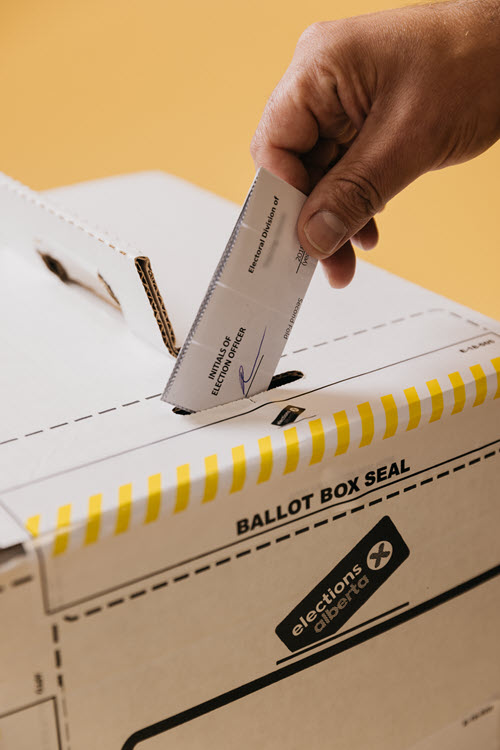
Several would require amendments to the Canadian Constitution and cooperation from governments outside Alberta. One raises the possibility of beginning a process that could eventually lead to a separate referendum on Alberta leaving Canada.
Whatever your political beliefs, these questions deserve more than a quick Yes or No.
This article is not intended to tell anyone how to vote.
Its purpose is much simpler:
What are we actually being asked — and what could happen if these proposals were ultimately implemented?
First: The Referendum Results Are Not Binding
Before looking at any individual question, this is probably the most important fact to understand.
According to Elections Alberta, the results of all ten referendum questions are non-binding.
That means the referendum itself does not automatically change Alberta law or the Canadian Constitution.
Depending on the question, a result could instead give the Alberta government a political mandate to introduce legislation, negotiate with Ottawa or other provinces, or pursue constitutional amendments.
In other words:
A Yes vote may express support for pursuing a proposal. It does not necessarily mean that proposal automatically becomes law.
Read the official referendum questions — Elections Alberta
Question 1 — Greater Alberta Control Over Immigration
The first question asks whether Alberta should take increased control over immigration for the purposes of decreasing immigration to what the question describes as sustainable levels, prioritizing economic migration and giving Albertans first priority for new employment opportunities.
What a Yes vote would mean
It would indicate public support for Alberta seeking greater influence over immigration policy.
That could include attempts to increase Alberta’s influence over the number or categories of immigrants coming to the province and placing greater emphasis on economic immigration and labour-market needs.
What it would not do
It would not immediately give Alberta complete control over immigration.
Immigration is unusual under the Canadian Constitution because both Parliament and provincial legislatures have authority in this area.
Section 95 of the Constitution Act, 1867 permits provinces to make immigration laws, but also provides that provincial immigration legislation operates only insofar as it is not inconsistent with federal legislation.
So substantially expanding Alberta’s immigration authority could require negotiations with Ottawa and potentially other legal or constitutional changes, depending upon what Alberta ultimately attempted to do.
The bigger issue
The question is therefore not simply about whether immigration should increase or decrease.
It also raises a fundamental question about which level of government should control immigration policy affecting Alberta.
Read Section 95 of the Constitution Act — Justice Laws Website
Question 2 — Who Should Qualify for Alberta-Funded Services?
Question 2 proposes that provincially funded programs such as health care, education and other social services be available only to:
Canadian citizens, permanent residents and individuals with an Alberta-approved immigration status.
Who could potentially be affected?
The important category here is people who are legally in Canada under a non-permanent immigration status.
Depending upon how future legislation was written, Alberta could establish additional eligibility requirements for some temporary residents before they could receive particular provincially funded services.
Possible repercussions
Supporters could argue that provincial services financed by Alberta taxpayers should primarily benefit citizens, permanent residents and people whose immigration status Alberta recognizes.
On the other hand, temporary residents may also work, study, operate businesses and pay taxes in Alberta.
Restricting eligibility could therefore affect temporary workers, international students and their families.
There is another important uncertainty:
The referendum question does not contain the legislation.
We do not yet know exactly which programs would be affected, which immigration categories would qualify, or what exemptions might be created.
Those details would determine the actual impact.
Question 3 — A 12-Month Waiting Period for Social Supports
Question 3 asks whether people with a non-permanent legal immigration status should be required to live in Alberta for at least 12 months before qualifying for provincially funded social-support programs.
Canadian citizens and permanent residents would continue to qualify as they do now.
What this could mean
Some temporary residents could be required to support themselves during their first year in Alberta without access to particular provincial social-support programs.
Pay attention to the wording
The question refers specifically to:
“provincially-funded social support programs.”
It does not provide a definitive list of those programs.
That matters.
The consequences could look very different depending upon which programs were ultimately included and whether exceptions were created for emergencies, children, vulnerable people or particular categories of temporary residents.
Again, Albertans are voting on a policy direction, not the details of a finished law.
Question 4 — Health-Care and Education Premiums
Question 4 asks whether people with non-permanent immigration status should pay a “reasonable fee or premium” toward their own and their family’s use of Alberta’s health-care and education systems.
Canadian citizens and permanent residents would continue qualifying as they currently do.
What a Yes vote would support
It would support the principle that at least some temporary residents should contribute an additional amount toward these provincial systems.
What we don’t know
The referendum question does not specify:
- how much the premium would be;
- which temporary immigration categories would pay it;
- whether children would be treated differently;
- whether employers could pay the premium;
- whether there would be income-based exemptions;
- or precisely which health and education services would be covered.
Those are not minor details.
They could determine whether the policy ultimately amounted to a modest contribution or a significant additional expense for temporary residents and their families.
Question 5 — Proof of Citizenship to Vote
Question 5 asks whether people should be required to provide proof of Canadian citizenship — such as a passport, birth certificate or citizenship card — to vote in an Alberta provincial election.
An important distinction
The question is not asking whether non-citizens should be permitted to vote.
Canadian citizenship is already a requirement for voting in Alberta provincial elections.
The proposed change concerns how citizenship would be verified.
What could change
Voters could be required to produce documentary proof of citizenship rather than relying solely on the existing voter-identification process.
The trade-off
The proposal could provide more direct verification that every person casting a ballot satisfies the citizenship requirement.
However, eligible Canadian citizens who do not possess readily accessible citizenship documents could face an additional step before voting.
The practical impact would therefore depend heavily on what documents were accepted and what alternative procedures were available to eligible voters who lacked them.
Question 6 — Who Should Select Alberta’s Superior-Court Judges?
With Question 6, we move firmly into constitutional reform.
The question asks whether Alberta should work with other willing provinces to amend the Canadian Constitution so that provincial governments — rather than the federal government — select justices appointed to provincial King’s Bench and Appeal courts.
What would change?
Under the existing Constitution, superior-court judges are federally appointed.
The proposal would transfer substantially more influence over those appointments to provincial governments.
Why this matters
Judicial appointments involve more than administration.
Courts interpret provincial and federal legislation, review government actions and decide constitutional cases.
Changing who selects superior-court judges would therefore alter an important part of Canada’s constitutional structure.
What a Yes vote would not do
It would not immediately transfer judicial appointments to Alberta.
The question specifically asks whether Alberta should work with other provinces to amend the Constitution.
That means Alberta cannot accomplish the proposed change simply by passing an ordinary provincial law.
Read the Constitution Acts — Justice Laws Website
Question 7 — Abolishing the Canadian Senate
Question 7 asks whether Alberta should work with other provinces to abolish the Senate of Canada.
This question deserves careful attention because abolition and reform are very different things.
A Yes vote would not abolish the Senate
The Supreme Court of Canada considered this exact constitutional issue in its 2014 Reference re Senate Reform.
The Court concluded that abolishing the Senate requires unanimous consent: the Senate, House of Commons and legislative assemblies of all Canadian provinces must agree.
Alberta therefore cannot abolish the Senate by itself, regardless of the referendum result.
Abolition is not Senate reform
This referendum question does not ask:
Should the Senate be elected?
It does not ask:
Should every province receive equal Senate representation?
And it does not ask:
Should Canada create a Triple-E Senate — elected, equal and effective?
It asks whether Alberta should work toward abolishing the institution entirely.
That distinction is especially relevant for Alberta because the Senate was created partly to provide regional representation within Canada’s Parliament.
Albertans therefore may wish to consider two separate questions:
Does the current Senate adequately represent Alberta?
And if the answer is no:
Would Alberta’s interests be better addressed through Senate abolition or Senate reform?
Only abolition is on this referendum ballot.
Read the Supreme Court’s Reference re Senate Reform
Question 8 — Opting Out of Federal Programs While Keeping Alberta’s Share of the Funding
Question 8 concerns federal programs operating in areas of provincial jurisdiction.
The proposed constitutional change would allow a province to opt out of such a federal program while still receiving its share of the associated federal funding.
What could that look like?
Imagine Ottawa established a national program in an area falling within provincial jurisdiction and attached national conditions to the funding.
Under the proposed arrangement, Alberta could potentially decline participation in that federal program while receiving its share of the funding and designing its own provincial alternative.
Potential benefit
This could give Alberta considerably greater flexibility to design programs around provincial priorities and circumstances.
Potential repercussion
If provinces increasingly operated different programs with the same federal funding, Canadians could experience substantially different public programs depending upon where they lived.
The underlying issue is therefore larger than funding.
It concerns the balance between provincial autonomy and national standards.
And once again, this would require constitutional change.
A Yes vote from Albertans would express support for Alberta pursuing that change; it would not create the constitutional provision by itself.
Question 9 — Provincial Laws Taking Priority Over Federal Laws
Question 9 could represent one of the most significant changes to Canadian federalism contemplated by these referendum questions.
It proposes amending the Constitution so that provincial legislation would take priority over conflicting federal legislation in areas of provincial or shared constitutional jurisdiction.
How does it work now?
Canada’s Constitution divides legislative authority between Parliament and provincial legislatures.
Some subjects also involve overlapping authority.
Where valid federal and provincial laws conflict in certain circumstances, the constitutional doctrine of federal paramountcy can make the federal law prevail to the extent of the conflict.
Immigration provides an especially clear written example: Section 95 expressly provides that provincial immigration legislation operates only insofar as it is not inconsistent with federal legislation.
What Question 9 proposes
The proposal would change that balance by giving provincial legislation priority in the circumstances described by the question.
If ultimately incorporated into the Constitution, that could significantly increase provincial authority relative to Ottawa.
The potential consequence
Supporters could see this as strengthening provincial autonomy and restoring authority to provinces in their constitutional spheres.
Others could be concerned that reversing federal paramountcy in shared areas could create conflicting legal regimes across Canada or weaken the federal government’s ability to implement national policies.
Either way, this is not a minor administrative change.
It concerns the basic distribution of governmental power within Canada.
And Alberta cannot make that constitutional change unilaterally.
Read the Constitution Acts — Government of Canada
Question 10 — Alberta’s Future Within Canada
Question 10 will understandably receive enormous attention.
But it is essential to understand what Albertans are — and are not — being asked.
The ballot presents two choices.
Option 1: Alberta should remain a province of Canada.
Option 2: The Government of Alberta should commence the legal process required under the Canadian Constitution to hold a future binding provincial referendum on whether Alberta should separate from Canada.
This is not the separation referendum
Choosing Option 2 would not make Alberta independent.
It would support beginning the legal process toward another referendum dealing specifically with separation.
What if a future referendum supported separation?
Even that would not mean Alberta automatically became an independent country the next morning.
The Supreme Court of Canada addressed this issue in the landmark Reference re Secession of Quebec.
The Court determined that a province cannot unilaterally secede from Canada under the Constitution.
However, a clear majority voting in favour of secession in response to a clear question would create a constitutional obligation for the other participants in Confederation to enter negotiations.
And those negotiations could be enormous
A separation process could potentially require negotiations concerning matters such as:
- constitutional arrangements;
- division of assets and liabilities;
- federal debt;
- borders;
- Indigenous and treaty rights;
- minority rights;
- pensions and federal programs;
- trade and movement between Alberta and the rest of Canada;
- and numerous other legal and economic relationships.
The Supreme Court made another important point:
The outcome of those negotiations would not be predetermined.
A referendum result could initiate the process, but Alberta could not simply dictate the terms of separation to Canada and the other provinces.
Read the Supreme Court’s Reference re Secession of Quebec
So What Are Albertans Really Deciding?
When all ten questions are placed beside one another, a larger pattern becomes visible.
Questions 1–5 concern immigration, eligibility for provincially funded services and voting requirements.
Questions 6–9 concern something different: the constitutional distribution of power between Alberta, the provinces and Ottawa.
Question 10 goes considerably further by asking whether Alberta should remain a province of Canada or begin the legal process toward a future binding referendum on separation.
These are not ten versions of the same political question.
Albertans can consider each one independently.
Someone could support greater provincial autonomy while opposing separation.
Someone could believe the existing Senate does not serve Alberta well while preferring Senate reform to Senate abolition.
Someone could support reducing immigration while disagreeing with charging temporary residents for particular public services.
Someone could strongly support remaining in Canada while also believing that the constitutional balance between Ottawa and the provinces needs reform.
Those positions are not inherently contradictory.
That is precisely why each question deserves to be considered on its own merits.
Before You Mark the Ballot
Referendums reduce complicated public-policy and constitutional questions to very simple choices:
Yes.
No.
Or, in Question 10, one of two options.
But the consequences behind those choices aren’t simple.
Before October 19, read the questions themselves.
Ask what the Alberta government could actually accomplish on its own.
Ask what would require federal cooperation.
Ask what would require other provinces to agree.
Ask what would require changing Canada’s Constitution.
Consider the potential benefits.
Consider the potential unintended consequences.
And most importantly, distinguish between what your referendum vote expresses politically and what it actually changes legally.
Then make your own decision.
Because whatever Albertans ultimately decide about their province and its relationship with Canada, decisions this consequential deserve something more valuable than political slogans.
They deserve understanding.
Sources & Further Reading
Elections Alberta — 2026 Provincial Referendum
Official wording of all ten referendum questions and information concerning their non-binding status.
https://www.elections.ab.ca/elections/referendum/
Justice Laws Website — Constitution Acts, 1867 to 1982
Official federal text of Canada’s Constitution.
https://laws-lois.justice.gc.ca/eng/const/
Section 95 — Agriculture and Immigration
Constitutional provisions governing concurrent federal and provincial immigration powers.
https://laws-lois.justice.gc.ca/eng/const/section-95.html
Supreme Court of Canada — Reference re Senate Reform, 2014 SCC 32
The Court’s decision explaining the constitutional requirements for Senate reform and abolition.
https://decisions.scc-csc.ca/scc-csc/scc-csc/en/item/13614/index.do
Supreme Court of Canada — Reference re Secession of Quebec
The leading decision concerning unilateral secession, clear referendum results and the constitutional obligation to negotiate.
https://decisions.scc-csc.ca/scc-csc/scc-csc/en/item/1643/index.do